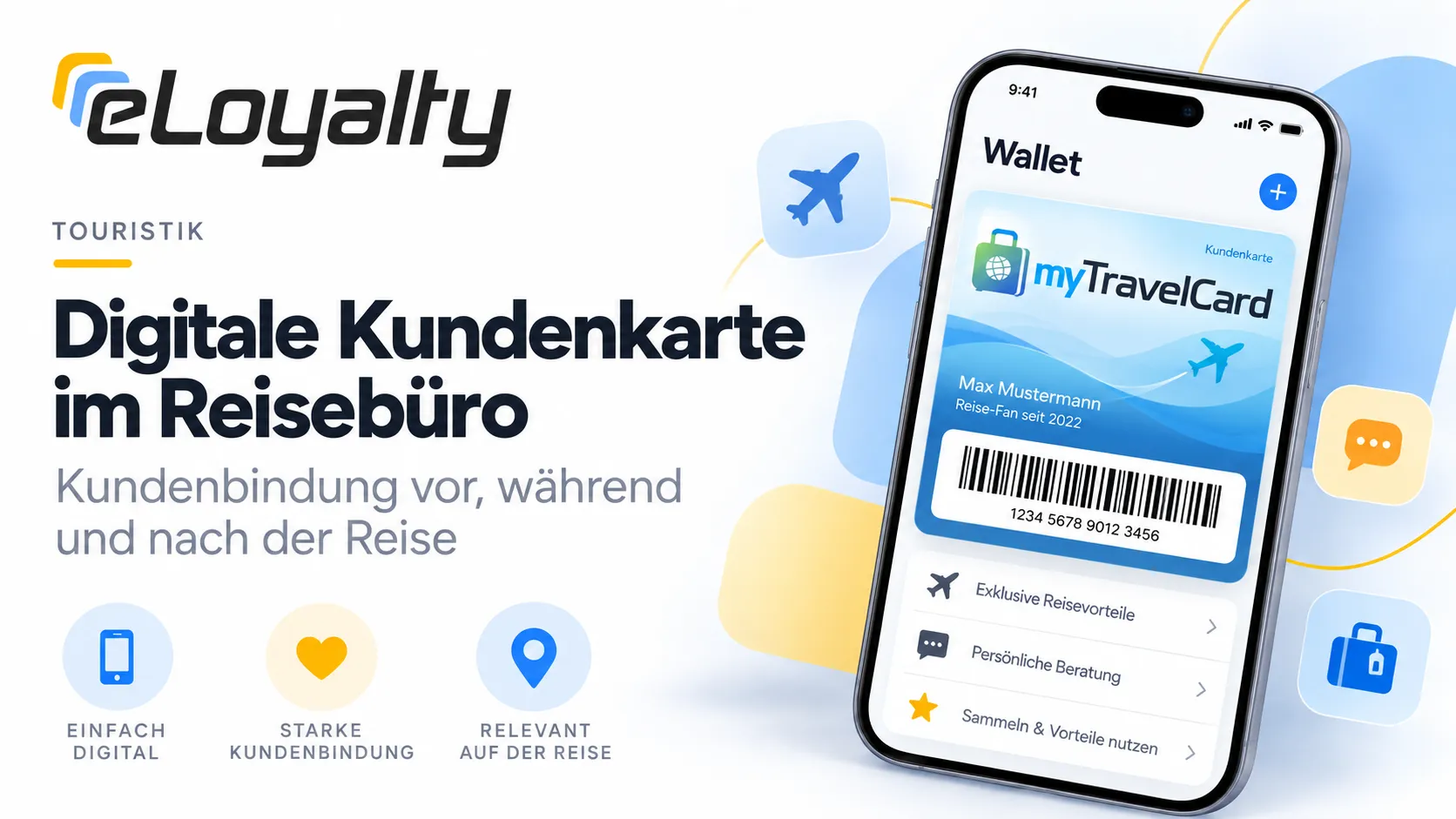
Before, During, and After Travel: Your Wallet Pass as a Digital Travel Companion
A practical guide for travel agencies and tourism providers: Which information and services in the wallet are truly relevant at which time.
'/%3e%3ccircle%20cx='14.6'%20cy='14.6'%20r='1.6'%20fill='%23DBEAFE'/%3e%3ccircle%20cx='29.6'%20cy='14.6'%20r='1.6'%20fill='%23DBEAFE'/%3e%3cpath%20d='M16.2002%2026.4C18.2002%2028.4%2020.6%2029%2023%2029C26.2%2029%2027.8002%2027.6%2029.0002%2026'%20stroke='%23DBEAFE'%20stroke-width='1.6'%20stroke-linecap='round'/%3e%3cdefs%3e%3clinearGradient%20id='paint0_linear_5405_2298'%20x1='23'%20y1='14'%20x2='0.5'%20y2='32'%20gradientUnits='userSpaceOnUse'%3e%3cstop%20stop-color='%231E40AF'/%3e%3cstop%20offset='1'%20stop-color='%230D1B49'/%3e%3c/linearGradient%3e%3c/defs%3e%3c/svg%3e)
eLoyalty Team
Aktualisiert am 01.10.2026 · 7 {value} min. Lesezeit
A journey is not just one purchase moment. Between "We would like to leave in October" and "We are back now," there are weeks or months full of questions, expectations, and small decisions.
This is precisely why tourism is particularly suitable for wallet passes.
Unlike a classic discount card, relevant content changes over time. Before the trip, preparation is key. On departure day, orientation matters. During the vacation, service is essential. Afterward, memories and reconnections count.
The wallet pass can connect these phases.
The Biggest Mistake: Creating a Customer Card and Doing Nothing with It
Simply adding a logo, customer number, and phone number to a digital pass only replaces paper – it does not create a digital channel.
The more compelling question is: What information is valuable for this customer right now?
This is the foundation for an event-driven customer journey.
Instead of "weekly newsletter on Thursdays," think in terms of events:
- Booking confirmed
- Departure date approaching
- Entry requirements changed
- Customer arrives at destination
- Transfer or check-in coming up
- Trip ending
- Customer is home again
- New travel occasion arises
Communication thus follows the journey rather than an editorial calendar.
Phase 1: After Booking – Creating Assurance
Right after a booking, the primary focus should not be on making the next sale. It is about orientation.
A wallet pass can consolidate:
- Booking or customer number
- Contact details of the travel agency
- Emergency or service contact
- Link to travel documents
- Entry and destination information
- Insurance, transfer, or mobility tips
- Relevant service benefits
This does not automatically eliminate every query, but it creates a familiar digital space where the customer can find information.
Best Practice
Don’t phrase the invitation in technical terms:
Weak: "Here you can download your wallet pass."
Better: "Save your digital travel companion – with your key contacts, travel tips, and current updates."
The benefit sells the pass, not the file format.
Phase 2: Two to Four Weeks Before Departure – Preparing Instead of Promoting
Now is the time to provide practical assistance.
Good content includes:
- Entry information
- Validity of documents
- eSIM or roaming
- Transfer options
- Airport parking
- Seat or baggage services
- Weather and packing tips
- Deadlines or schedules
The key is not to send everything at once.
A wallet pass gains value when it is curated. A customer traveling to Iceland needs different information than a family on a package trip to Mallorca.
Phase 3: Just Before Departure – The Moment of Highest Relevance
Just before the trip, attention spikes. This is when push communication is particularly effective – and particularly sensitive.
A good message addresses a specific problem:
"Your departure is in two days. Here are the current entry guidelines and your contact person."
A bad message uses anxiety as mere advertising space:
"Today only: 12% off some ancillary product."
Strategic studies outline a clear rule: Service before Loyalty before Commerce.
Only when the customer perceives the pass as useful will additional offers be seen as service rather than sales pressure.
Phase 4: At the Destination – Time and Place Become Context
This is where wallet passes reveal their unique advantage: time- and location-based relevance.
The eLoyalty materials illustrate this with an example of a welcome message upon arrival in Mallorca. Possible inclusions could be:
- Contact details for the tour guide
- Information for transfer or meeting point
- Local service information
- Relevant excursions
- Mobility offers
- Local partner benefits
Geofencing should not be an end in itself. No one needs a message simply because it is technically feasible.
The key question is:
Would this information be significantly less useful at a different place or time?
If so, then geofencing makes sense.
Phase 5: During the Trip – Additional Sales Without Clutter
Additional services are a vital economic lever in tourism. However, the underlying study on cross-selling and upselling warns against a simplistic logic of "selling more."
A good ancillary offer fulfills at least one of these functions:
- Saves time,
- Reduces risk,
- Increases comfort,
- Enhances the experience,
- Solves a specific problem.
Examples:
City trip: "Tomorrow will be very hot. There are still spots available for the early guided tour."
Rental car trip: "There is a road closure reported for your route today. Alternative route and parking information here."
Package trip: "You’ve been on-site for two days. Would you like to look at a boat excursion for Thursday?"
This is commerce, but commerce with context.
Phase 6: Return – Turning Travel Companionship into Customer Retention
Many companies end their communication with the service delivery. In the travel agency context, this is particularly unfortunate, as the return is an ideal moment for relationship maintenance.
A sensible process might look like this:
2–5 Days After Return: Short feedback request or personal greeting.
After 30 Days: Service follow-up or request for a review.
After 90–120 Days: New inspiration related to the known travel motif.
At Seasonal Milestones: Holiday calendar, anniversary, or relevant early booking phase.
This way, the pass does not become a continuous advertising channel but rather a digital memory of the customer relationship.
A Concrete Example: The Müller Family Flies to Crete
The family books in January for July.
In January, the customer card is saved. It contains the travel agency's contact, customer number, and a link to the travel overview.
In June, the pass is updated: documents, transfer, entry information, and eSIM tip appear.
Three days before departure, a single service push is sent.
Upon arrival, a location-based welcome message may appear.
On the third day of the vacation, a family-friendly excursion could be proposed, if appropriate and permitted.
After return, the pass reverts to a general customer card mode.
This may sound unremarkable. That's the strength: the technology fades behind a good process.
What Small Travel Agencies Can Learn
You don’t need a highly complex AI orchestration to get started. A good MVP can start with five functions:
- Travel overview or reference
- Contact person
- Important service and entry information
- Relevant updates
- Exactly one clear ancillary service
The strategic study even recommends consciously limiting marketing and commerce pushes. This is wise. Attention in the wallet is scarce.
The Wallet Pass as Part of a System
A wallet pass should not become a new data silo. Ideally, it should be connected with existing processes:
- CRM or mid-office
- Booking system
- Content or service sources
- Customer segments
- Consent and preferences
- Analytics
eLoyalty acts as the experience and communication layer: The pass makes existing information mobile and visible and enables updatable touchpoints.
Five Rules for a Good Tourism Wallet Journey
1. Every update needs a reason.
No message without a concrete benefit.
2. The travel phase dictates the content.
Inspiration before booking, security before departure, service during the trip, relationship afterward.
3. Push is scarce.
Not everything that can be sent should be sent.
4. Additional sales must enhance the trip.
The right offer at the right time is service. A random coupon is advertising.
5. The travel agency's brand must remain visible.
Especially as more travel planning occurs through platforms and AI interfaces, maintaining direct customer contact becomes valuable.
Conclusion
The best digital travel companion is not the one with the most features. It is the one that is useful at the right moment.
A wallet pass can exactly take on this role: less app, less paper, less scatter loss – more context.
Source Basis
The foundation consists of the provided studies on wallet passes and hyper-personalization, dossiers on loyalty, AI marketing, and ancillary sales, as well as eLoyalty product and consulting materials.
Auf dieser Seite
- The Biggest Mistake: Creating a Customer Card and Doing Nothing with It
- Phase 1: After Booking – Creating Assurance
- Phase 2: Two to Four Weeks Before Departure – Preparing Instead of Promoting
- Phase 3: Just Before Departure – The Moment of Highest Relevance
- Phase 4: At the Destination – Time and Place Become Context
- Phase 5: During the Trip – Additional Sales Without Clutter
- Phase 6: Return – Turning Travel Companionship into Customer Retention
- A Concrete Example: The Müller Family Flies to Crete
- What Small Travel Agencies Can Learn
- The Wallet Pass as Part of a System
- Five Rules for a Good Tourism Wallet Journey
- Conclusion